Losing Jesus
I feared I might lose him. Instead, I'm watching much of the Church reshape him into something unrecognizable.

During my early days of deconstruction (disorientation, renegotiation, restructuring, or whatever you want to call it), I intentionally avoided certain books and ideas. Because I was afraid. Afraid of where they might lead. And at least earlier in the process, I just wasn’t ready to go there.
Deconstruction is disorienting. My entire worldview, everything I once held with absolute certainty, collapsed. The structure didn’t crack; it came crashing down. And I was left scrambling for whatever foundation might still exist.
In its place came a flood of things I wasn’t used to carrying. Confusion. Disillusionment. Sadness. Anger. Loneliness. Whatever sense of understanding or control I thought I had was gone.
Over time, some of that inner landscape was rebuilt. And strangely, it led me to a bigger God—one who was kinder, more expansive, more aligned with the person of Jesus. It allowed the Bible to be what it is, instead of forcing it into something it never seemed to be. My faith became something that felt more honest. More true.
I began facing things head-on, trusting that God was real, and that if he really cared about me, he wouldn’t abandon me. If I wandered too far, I believed he would bring me back.
But there was one place I resisted going.
Jesus.
I was afraid of losing him. He was that foundation. He was the thread still holding everything together. And if I lost Jesus, what was left?
There were a few books I held onto for years before I could bring myself to read them, among them Bart Ehrman’s Misquoting Jesus, Forged, How Jesus Became God. They sat there, waiting for the day I might finally be ready to open them.
Eventually, that day came. I was still nervous of where it might lead. But I had come to the place where I felt like was finally ready.
And once again, things shifted. Not in the way I expected. These books didn’t dismantle my faith so much as give evidence to things I had already begun to suspect. It felt less like losing something and more like maybe finally seeing it more clearly.
There is a saying that when the student is ready, the teacher will appear. I think this is essentially what happened to me.
Did I lose Jesus?
No. And yes.
Some of my ideas about him fell away. Some of the frameworks I had built didn’t hold. In some ways, he became less “personal” than he had been. And there were things that felt hard about that—there was some loss.
But in other ways, he became more.
More human. More real. Less an object to believe in, and more a way to live. A way to move through the world. A way to be.
So yes, the foundation changed. But it didn’t collapse.
Why am I writing this now?
Because of this image by David Hayward, also known as Naked Pastor.
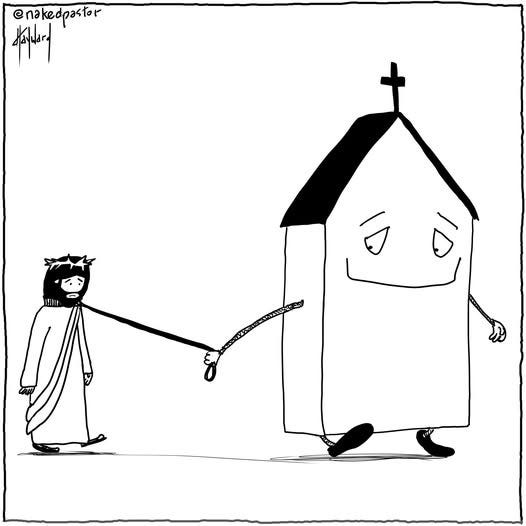
A small, simple drawing. But it stopped me. It stayed with me. And the more I sat with it, the heavier it became.
Jesus, being dragged.
Not by the world. Not by outsiders.
By the Church. With a smile on its face.
For so long, I was afraid of losing Jesus.
But looking at this, I realized something else:
Much of the Church already has.
The Jesus who brought good news to the poor, to the outcast, to those pushed aside by religious power… this is not the Jesus much of the American Church reflects today.
The Jesus of the Sermon on the Mount, who taught the upside-down Kingdom of the beatitudes, radical love, enemy-love, trust, humility, inner transformation… would likely be dismissed now as weak, naïve, “woke.”
The Jesus who told the story of the Good Samaritan, expanding “neighbor” to include the very people we despise… has been replaced by a version that justifies exclusion, suspicion, and violent expulsion of the foreigner with some of the most dehumanizing methods.
The Jesus who revealed God as a loving father running toward his lost child… has been reshaped into a God eager to punish, exclude, and condemn.
The Jesus whose harshest words were reserved for religious leaders and systems of power… has been co-opted by those same systems to silence, shame, and crush the vulnerable.
The Jesus who warned that you cannot serve both God and wealth… has been turned into a mascot for accumulation, protection, and self-interest.
The Jesus who said love is the greatest commandment—loving God and loving neighbor… has been invoked to justify actions that are anything but loving. Harmful. Cruel. Dehumanizing.
And all the while, the focus shifts to gatekeeping—who’s in, who’s out, who qualifies, who doesn’t… rather than the love, compassion, and justice he actually embodied.
This is what the image reveals.
Not just a Church that has lost Jesus.
But a Church that is dragging him, reshaping him, forcing him, bending him into something he never was.
Turning him into a mascot to worship rather than someone to actually follow.
Using his name to justify fear. Violence. Control. Division.
I’ll admit, there is a version of Jesus I’ve lost.
But in losing that version, I think I’ve found something more grounded. More real. And something I can actually follow.
I’m not sure the same can be said for much of the Church.
So much grace filled truth in this article. Thanks Michael.
Beautiful. Thank you for sharing!